How to edit an article with AI without losing your voice
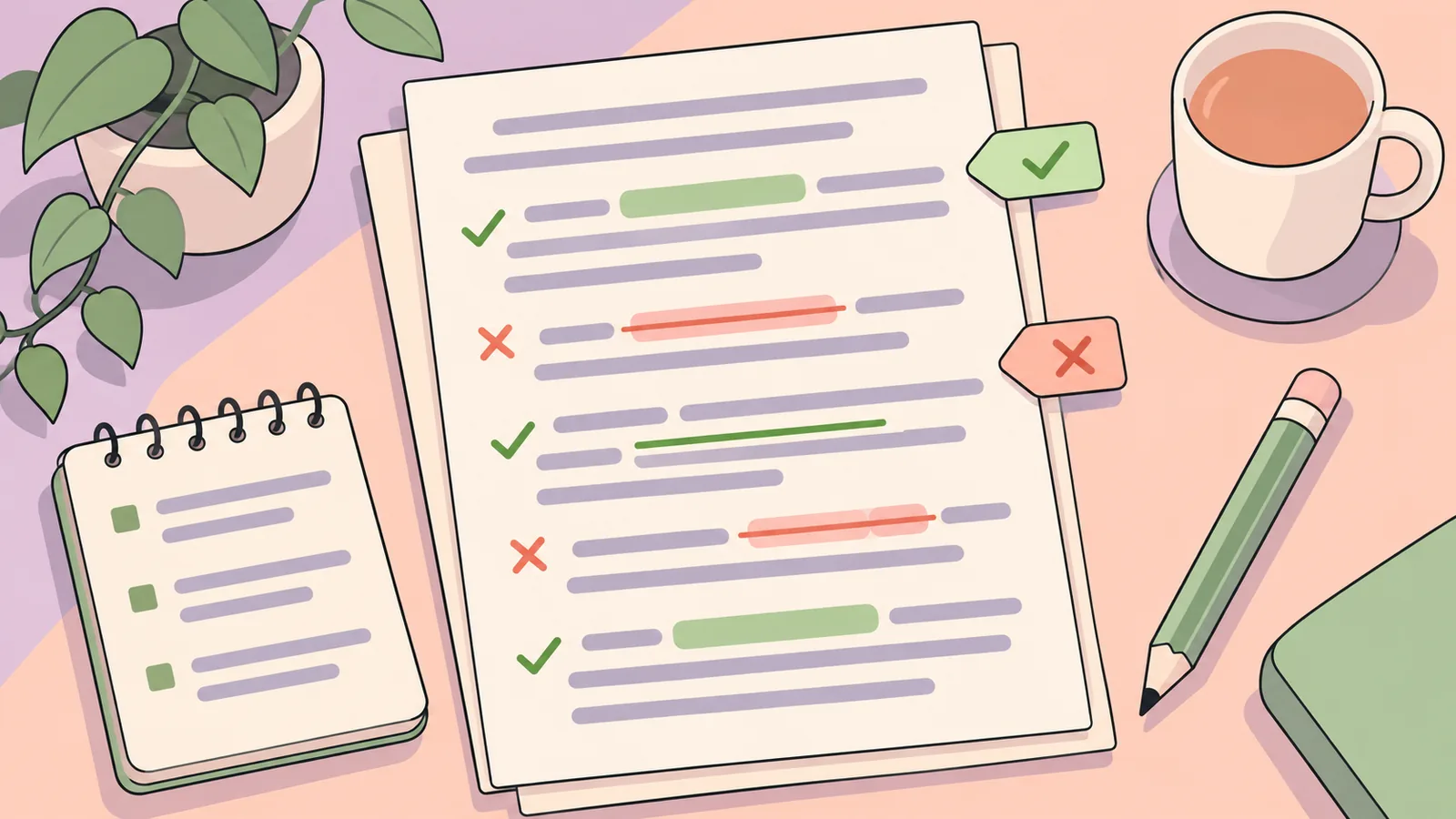
To edit an article with AI, give the assistant a finished draft, its purpose, and a narrow job. Ask it to identify gaps before it rewrites anything. Then request changes to one section at a time, compare each suggestion with the original, and keep only edits that improve clarity without changing facts or flattening your voice. The final read and every factual decision remain yours.
Working section by section may sound slow. But a full rewrite gives you much more to check: the argument may have shifted, a useful detail may have disappeared, or every paragraph may now sound alike. With smaller requests, you can see what changed and decide whether it helps.
Consider a draft about a neighborhood repair group that collects broken lamps, assesses them, and returns them to owners. The information is there, but the opening wanders. One section repeats itself, and the ending loses its practical point. The writer has a direct, slightly wry voice worth keeping as you work through those problems.
Start with the article you actually have
Save a copy of the finished draft before you open a chat. Label it clearly, such as lamp-repair-original. If your editor has version history, keep the original version there as well. You will need it when you compare changes later. It is hard to judge a polished sentence when you cannot remember what it replaced.
Write a short editing brief. The assistant needs to know what the piece is trying to do, who will read it, and which details must survive. For our repair article, the brief is simple: readers want to understand what happens when they bring in a broken lamp, what the volunteers can and cannot do, and how to prepare before visiting. The voice is plain, practical, and occasionally dry. The article must not promise that every lamp can be repaired.
Gather the supporting material that belongs with the draft: source notes, interview transcript, product documentation, or a list of facts you have checked. Provide only the parts needed for the editing task. If an assistant cannot see a source, tell it so. Do not ask it to fill the gap from memory. The Habr account of editing an existing article with an assistant describes using notes and related files as context, then manually checking the proposed additions and the article's overall narrative. That sequence is useful even if you work in a plain document and a browser chat.
For sensitive drafts, check your organization's rules and the tool's data settings before sharing text. You can also work on a short excerpt with names and identifying details removed. The editing method does not depend on giving an assistant your entire archive.
Ask for a diagnosis before a rewrite
Ask the assistant to read for problems before it starts fixing sentences. Its comments should be specific enough for you to check against the draft:
Read this finished article as an editor. Its reader wants to know what happens at a lamp repair session and how to prepare. Identify up to five places where the sequence is confusing, a claim needs support, or a paragraph repeats information. Quote the relevant sentence and explain the reader's likely question. Do not rewrite the article or add facts.
The prompt asks the assistant to point to the text behind each criticism. "The article needs more depth" is too vague to act on. "The opening says volunteers assess lamps, but the next section begins with collection before explaining where owners leave them" gives you a choice: move a sentence, add a transition, or leave the order as it is.
Our draft begins like this:
The workshop began with three people and a table of donated tools. Today the volunteers inspect lamps, discuss likely faults, and tell owners whether a repair is possible. A visitor should bring the lamp and any detachable parts. Our group has always believed that repair is an important community skill.
The opening mixes the group's history and mission with instructions for visitors. Someone trying to understand a visit has to work out which details matter first. The assistant also flags "whether a repair is possible": it might sound like a guarantee of a complete diagnosis. That needs clearer wording about what volunteers can do, without promising an outcome.
One suggestion is less helpful: add a paragraph about how much waste the workshop prevents. The draft has no count and no method for estimating it. Even if the environmental benefit sounds plausible, you still need evidence for a figure. NIST's generative AI profile describes the risk of confidently presented false content. Watch for that in small edits too. A model may give a modest statement a precision the source does not support.
Make a small decision list before changing the draft:
| Suggestion | Decision | Reason |
|---|---|---|
| Put the visitor's next step first | Accept | It answers the opening question |
| Clarify what volunteers assess | Accept with revision | The current wording is broad |
| Add a waste reduction figure | Reject | The source material has no figure |
| Replace the dry line about tools | Reject | It carries the writer's voice |
Use the list to keep track of your decisions. A suggestion can sound good on its own and still be wrong for this article.
Edit the structure while the wording is still yours
Settle the section order before polishing sentences. Purdue OWL's revision guidance separates reorganizing a piece from later polishing. If a section is in the wrong place, perfecting its sentences first wastes effort.
Ask the assistant to map the section order:
Give me the current section order in one line each. Then propose an order that helps a first-time visitor follow the process. Mark any proposed section that would require information absent from the draft. Keep the existing facts and the writer's tone.
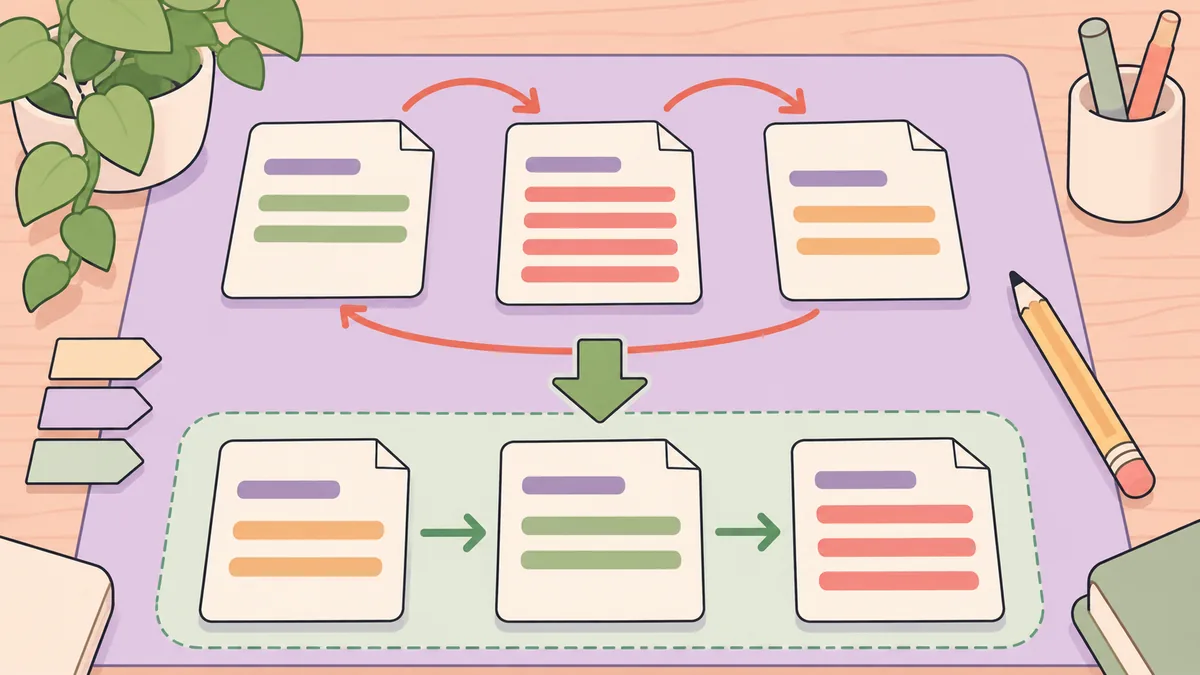
For the lamp article, the current path is history, intake, common faults, volunteer rules, what to bring, and a conclusion. For a visitor, it makes more sense to start with what to bring, then cover intake, assessment, possible next steps, and volunteer rules. The brief history can follow. Keep it in a short paragraph once the reader understands the process.
The assistant proposes an FAQ about repair fees. There is no fee information in the source notes. Leave that question for a person to answer, or omit it. Readers may want to know about fees, but a heading alone does not fill the gap. You need an answer you can support.
After moving the sections, read the transitions yourself. Check that each transition explains how the sections connect. If the article moves from intake to assessment, "Once the volunteer has your lamp and its loose parts, they can inspect the visible damage" is useful only if that is what actually happens. "Now let's explore the fascinating assessment process" occupies space without telling the reader anything.
Ask for a targeted sentence edit
Once the sections are in order, choose a paragraph that is hard to read. Say what needs fixing and which details must stay:
Shorten this paragraph for a reader who has never attended a repair session. Preserve every factual detail and the distinction between an initial inspection and a completed repair. Return the original and a proposed version, then list anything you removed or changed.
Here is the paragraph:
Before: At the first table, a volunteer looks over the lamp, asks the owner when the problem began, checks for visible damage, and decides whether the team can examine it further during that session, though an initial look does not mean the lamp will be repaired that day.
The assistant's first attempt sounds efficient:
After: A volunteer diagnoses the lamp at the first table and schedules its repair.
Reject it. The proposed sentence changes an initial look into a diagnosis and invents a schedule. It drops the owner's account, the visible damage check, and the warning that a repair may not happen that day. Those limits matter more than the shorter sentence.
Try a more precise instruction:
The last version changed the facts. Keep the owner's description, visible damage check, decision about further examination, and the fact that repair may not happen that day. Use two sentences if needed. Do not introduce a diagnosis or schedule.
After: At the first table, a volunteer asks when the problem began and checks the lamp for visible damage. The volunteer then decides whether the team can examine the lamp further during the session; that first look does not promise a repair that day.
This version keeps the process and its limits. The actions explain what "looks over" means, so that phrase can go. The warning gets its own clause, where a skimming reader is less likely to miss it. You may still want to adjust how the sentence sounds. Accepting the factual repair does not mean you have to keep every word of the suggestion.
Keep a voice sample beside the prompt
"Make it more engaging" gives the assistant little to work with. Tell it what you want to preserve in the writer's voice. Pick two or three short passages from the original article that sound like the writer. Describe them in plain terms: short direct sentences, concrete verbs, no sales language, one dry aside when it earns its place.
Our draft includes this line: "The box of mystery adapters has not solved a mystery yet." The line sounds like someone describing the workshop, and it does not change any facts. The assistant suggests: "Our dedicated volunteers leverage a comprehensive toolkit to deliver transformative repair experiences." That sentence has no place in the article. The promotional claim loses the workshop's physical detail. It also sounds nothing like the writer.
Show the assistant what to avoid:
Use the existing article's plain, practical voice. Keep concrete objects and the occasional dry aside. Avoid promotional adjectives, sweeping claims, and phrases such as "seamless experience" or "game changer." If a sentence already reads clearly, leave it alone. Suggest changes only where a reader could misunderstand it.
You can also ask for alternatives with a reason for each. "Give me two versions of this transition: one shorter, one more conversational. Explain what each version emphasizes" makes the choices visible. If neither sounds right, keep your original. You do not have to accept a sentence just because it reads smoothly.
For more ways to spot the repeated phrases and rhythms that can creep into a rewrite, see signs of AI writing and how to fix them. When you want a manual pass after the assistant's suggestions, the hand editing guide gives a separate checklist.
Use your notes to test proposed additions
An assistant may notice a missing explanation, but it cannot supply facts that are absent from the material you gave it. Treat "you should explain what happens to an unsafe lamp" as a question for the writer. The notes might answer it. If they do, add the answer in your own words and check it against the source. If they do not, do not turn a model's likely guess into a workshop policy.
A useful request is:
Compare the article with these source notes. List questions the article leaves open and point to the note that answers each one. For questions the notes do not answer, write "needs reporting." Do not draft new claims.
Suppose the notes say that volunteers will not work on a lamp with a damaged power cord at the public table. The article says only that some lamps cannot be examined during a session. The assistant can flag the missing condition and point to the note. You can then write a sentence with that limit and verify the wording with the organizer if the notes are ambiguous.
This approach borrows a useful principle from the Habr editing account: the author asks questions of a draft and related notes, then decides which suggested blocks belong in the article. The source also reports that a local setup helped with short, focused tasks but did not fully meet its hopes for broad access to the whole knowledge store. Give the assistant the context for each task, and keep the request small enough that you can review its answer.
Do not use a model's citation as proof without opening the cited page. A title may be real while the claimed finding is absent. If you add a number, date, technical requirement, or quotation, inspect the original source yourself. Research on why language models hallucinate explains why a confident answer can still be wrong. Compare the sentence you plan to publish with the evidence itself.
Check the edits in a side-by-side pass
After one section is revised, compare it with the saved draft. Look for four kinds of change: facts added, facts lost, certainty raised, and voice replaced. Better grammar does not make up for any of those losses.
The lamp article originally says, "Most visitors leave with either a plan for a repair or a clearer idea of the fault." A model changes it to, "Every visitor leaves with a repaired lamp or a complete diagnosis." The new line is punchier but turns "most" into "every," a plan into a completed repair, and a clearer idea into a complete diagnosis. None of those claims follows from the original. Restore the original or write a more precise line from verified notes.
Another edit removes "The box of mystery adapters has not solved a mystery yet." That is a voice loss rather than a factual error. Keep the line if it fits the surrounding paragraph. If it slows the process explanation, move it to the short history section. If moving it does not help, revise it as you would any other sentence.
You can ask the assistant to help audit its own revisions:
Compare these two versions. List every change to a number, date, actor, sequence, degree of certainty, promise, or quoted wording. Do not judge whether the changes are good. I will check them against the notes.
Use the list to help you find changes, then read both versions yourself. The assistant may miss a change in what a sentence implies. For a long article, do this section by section. A full-document comparison can bury an important changed word in a large list.
Make the final pass without the assistant
Read the article from the top as a visitor who has never met the group. Does the opening say what happens at the session? Can the reader tell what to bring? Are the limits on repair clear before the conclusion? If the article makes a claim about fees, safety, or timing, is there a source for it?
Then read it aloud or use a screen reader. Listen for sentences that sound like a brochure instead of a person explaining a process. Repeated sentence lengths, identical transitions, and abstract nouns are easier to notice when you hear them. When a sentence gets abstract, return to what it describes. Name the lamp or cord, or say what the owner or volunteer does at the first inspection.
Finally, check names, links, dates, and quotations against their sources. Proofreading comes after the content decisions; an AI writing helper that works in your editor can take the spelling and grammar pass once those decisions are made. Purdue OWL's proofreading suggestions emphasize slowing down and revisiting places where a reader has to pause or reread. If a polished sentence makes you stop and reread, it still needs work.
Keep the edit history. If a later reader questions a claim, you can see whether it came from the original draft, a source note, or an accepted suggestion. If you accept a substantial change, leave a comment explaining why. The next editor can check the decision, and you can reverse it if the claim turns out to be wrong.
A compact prompt sequence you can reuse
Use these as separate requests, with the relevant draft or excerpt attached each time. The sequence matters because a diagnosis should precede a rewrite, and a factual check should follow it.
- "Read this finished article for a reader who wants [specific answer]. Identify confusing order, repetition, and unsupported claims. Quote each problem. Do not rewrite."
- "Suggest a section order using only the material already in the draft. Mark any section that needs new reporting."
- "Edit this paragraph for [specific problem]. Preserve these facts: [list]. Keep the voice plain and concrete. Show the original and proposed wording, then list what changed."
- "Compare the two versions for changed facts, promises, timing, numbers, and certainty. List them without deciding whether they are correct."
- "Point out phrases in the revised section that sound promotional or unlike these voice samples: [samples]. Suggest only local alternatives."
If the assistant ignores a constraint, stop the rewrite and restate the constraint with the exact fact it changed. If it repeats the problem, make the edit yourself. There is little reason to keep prompting when you already know how to fix the sentence.
Questions writers ask about this workflow
Should I give the assistant the whole article?
Give it the whole article for a high-level diagnosis if the tool can handle the length and the text is appropriate to share. Include enough neighboring text for the assistant to understand the point of a section, even when you only want it to edit one paragraph.
When should I stop?
Stop when the article answers the reader's question and its claims match the sources. If the next pass only swaps one acceptable phrase for another, you are probably done. Read it once without the assistant before publishing.
The repair article ends with a straightforward next step: bring the lamp, its detachable parts, and a description of when the problem began; the volunteers will inspect it and explain what they can do during the session.