GPTZero AI Detector Review: Scores and Limits
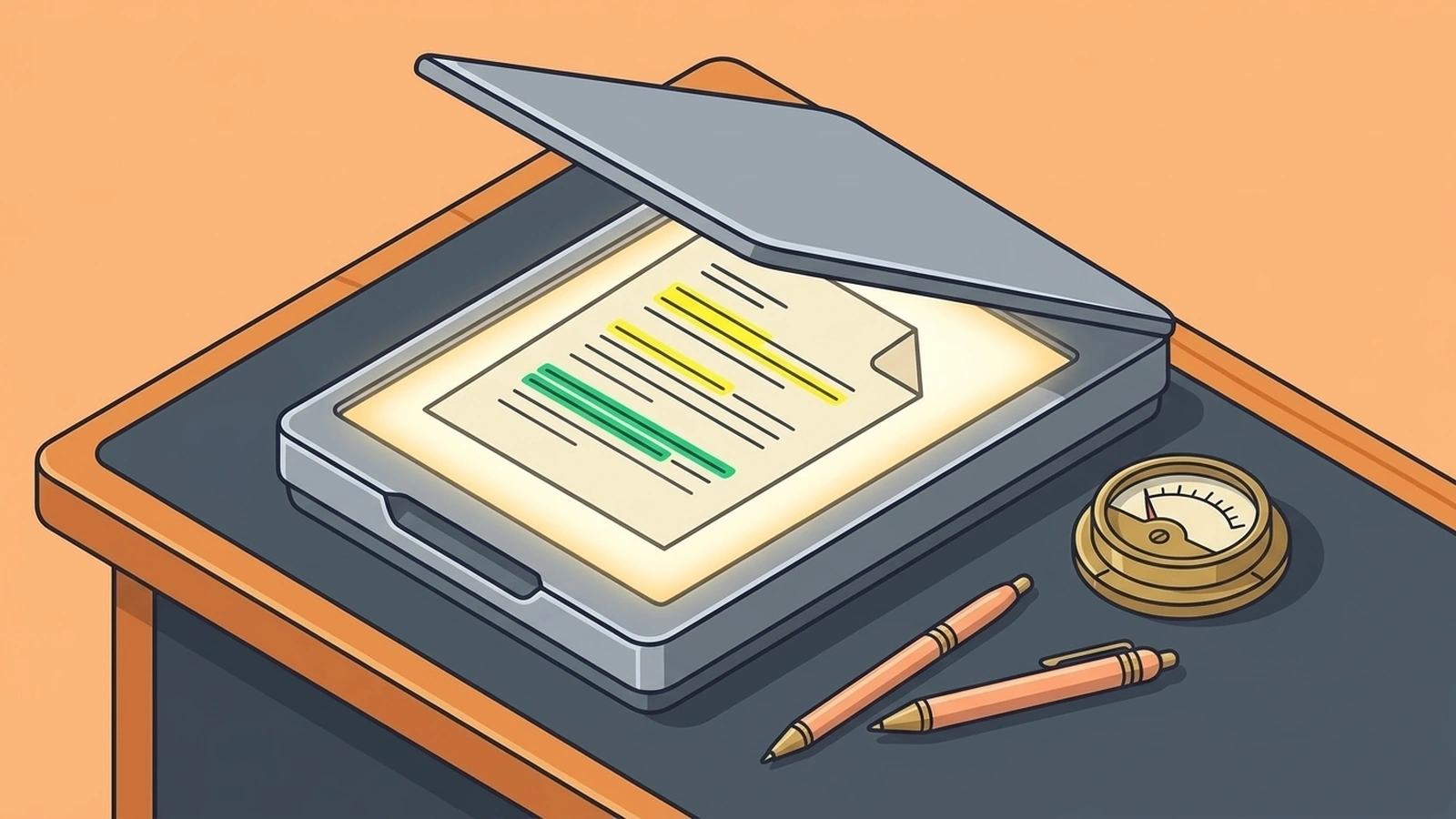
GPTZero estimates whether a passage resembles human writing, AI-generated writing, or a mix. Its result can give a reader a reason to look more closely, but it cannot establish who wrote a document. The vendor itself says human writing can be labeled AI and AI writing can be labeled human. It advises educators against using results to punish students.
We tried the public scanner with a real sample on November 22, 2026. The text was accepted into the input box, but clicking Scan did not produce a visible classification in our browser session. That limits this review: we can assess the interface, published guidance, and plans, but cannot honestly report a firsthand accuracy score.
Prices and allowances below come from GPTZero's own pricing page, checked on November 22, 2026.
How GPTZero Scores Text Under the Hood
You cannot reconstruct a GPTZero decision from its result screen. The company does not publish enough about its current model to do that. Its FAQ says it trains on human and AI writing, offers document and sentence level indications, and is more accurate on longer samples. Perplexity, burstiness, and classifier training help explain the difficulties of text detection. GPTZero keeps its present decision rules private.
Perplexity: The Surprise of Word Choices
Perplexity measures how well a probability model predicts a sample of text. An autoregressive language model calculates probabilities for possible next words, then selects tokens that fit those patterns. Generated prose therefore tends to favor words with a high probability in the surrounding text.
A predictable phrase can have low perplexity: it offers little surprise to the model reading it. But the value depends on which reference model you use and the context you give it. It cannot identify the writer.
The GLTR research paper describes a way to visualize how likely a reference model finds the words in a passage. It explains the statistical approach to detection without disclosing GPTZero's current method or validating its results.
Instructions and technical explanations often repeat terms for good reasons. Institutional templates do too. A detector trained on a limited set of examples may flag that common phrasing, even though it does not establish machine authorship. To find out how often this happens, you need to test comparable material.
Burstiness: The Cadence and Variation of Sentences
Burstiness often refers to variation across sentences. You can hear the difference between a passage of short, similarly shaped sentences and one that mixes lengths and structures. An editor can notice that rhythm without running a scan.
People write repetitive prose, and generated prose can vary its rhythm. Genre and editing affect both. Neither an even rhythm nor a varied one proves who wrote a passage.
GPTZero has described perplexity and burstiness in its public explanations, but its current decision rule is proprietary. The percentage on the screen does not tell you which features produced the result or how many the model used. Our guide to how AI detectors work explains these broader approaches.
Supervised Deep Learning Classifiers
The FAQ says the current model is trained on a large, diverse corpus of human-written and AI-generated text. It does not provide the training examples or weighting needed to audit a specific result independently.
When someone disputes a result, a highlighted sentence gives the reviewer somewhere to look. It does not expose the model's calculation or prove that the writer used a particular tool.
What the Results Screen Actually Means
Editors and instructors can misread the dashboard and accuse a writer on the strength of a score. Before acting on a result, check what the label and percentage mean.
Document-Level Classification: Human, AI, or Mixed
GPTZero's public page offers example categories labeled Human, AI + Human, Polished by AI, and Paraphrased by AI. These labels describe how the model interprets the text; they do not record the steps the writer took. If the label says mixed, the reviewer still needs to ask what use of AI was permitted and what actually happened.
The Probability Score: Confidence Versus Percentage
GPTZero describes its output as a confidence score. A percentage attached to a category is a model output, not a measured share of words written by a machine. It also is not proof that a named writer used AI. The vendor's FAQ explicitly acknowledges errors in both directions and says its classifier should flag cases for a conversation, not punishment.
A precise-looking percentage still needs context. Ask which version of the tool produced it, how much text was submitted, and whether the writing resembles the examples the model was trained on. The FAQ says accuracy improves with more text and is strongest on writing similar to its training data, mostly English prose written by adults.
Reading Sentence-Level Highlights
The vendor advertises sentence-level highlights in its paid plans. Read the marked sentences in context and compare them with the writer's drafts. A stock definition or template phrase may explain a highlight; sometimes the wording is simply ordinary. Colors and features can change as the interface changes, so use the legend on the screen you are viewing.
Our Scan Attempt: What We Could Actually Observe
On November 22, 2026, we opened GPTZero's public detector page in a desktop Chromium browser. Our sample was a 1,108-character passage of unedited AI-generated prose. The page accepted it, updated its character counter to 1,108 of 10,000, and offered an active Scan button.
Clicking Scan returned no visible classification, percentage, or sentence highlight. We waited, then tried a longer sample. Again, no result appeared. A browser or account issue could explain what happened, but the page gave us no way to identify the cause. This failed attempt does not show that the detector never works.
To test accuracy, start with saved, full-length documents whose writing histories are known. Include human writing and untouched AI output, as well as work revised under a stated policy. Record the exact input and test date, the account tier, and the result screen. Keep track of scans that fail to complete too. A handful of samples can show how the tool behaves, but measuring an error rate takes a much larger, better controlled set.
Look for those details in detector reviews. You cannot check a reported score without knowing what the reviewer submitted, when they tested it, and how they established the writing's origin. A striking percentage on its own tells you very little about reliability.
False Positives: Why Innocent Human Writing Gets Flagged
A false positive means the detector has labeled human writing as machine-generated. This is the most harmful kind of detection error in professional and academic settings: an accusation of dishonesty can derail a student's education or damage a writer's career. It also damages trust between writers and editors.
The Non-Native English Speaker Penalty
A writer using a second language may rely on familiar vocabulary and conventional sentence structures to make a point clearly. There is nothing wrong with those choices. A detector may nevertheless mistake that careful, conventional phrasing for generated text.
In a 2023 study of several detectors, Liang and colleagues found that the systems they tested often misclassified essays by non-native English writers. The findings raise a serious fairness concern, though they apply to the detectors and essay sets tested. They do not establish an error rate for GPTZero's present model or show that every current detector behaves the same way across genres.
An instructor reviewing a flagged essay should give the writer room to explain how they worked. Asking someone to make their English less clear or less formal to please a classifier is no solution.
Standardized Formal and Academic Formats
Academic papers and laboratory reports follow rigid conventions, as do medical summaries and legal briefs. These genres discourage conversational rhythm, rhetorical questions, and unexpected word choices.
A scientific paper requires passive voice, standard terminology, and methodical progression:
The solution was heated to seventy degrees Celsius and maintained at constant pressure for forty-five minutes. Samples were extracted at ten-minute intervals and analyzed via liquid chromatography.
This is conventional laboratory phrasing, where repetition can be appropriate. We did not scan the passage and cannot say how GPTZero would classify it.
Short Sample Limitations
GPTZero's FAQ says its document-level classification is more accurate than its paragraph-level result, which is more accurate than its sentence-level result. It gives no universal 250-word cutoff in the guidance we checked. With less context to work from, a short excerpt calls for more caution.
If you have only a sentence or two, ask for the surrounding work and assignment instructions. Review the drafting record before interpreting a score. Style alone gives you little basis for assigning authorship to such a short passage.
Worked Before and After Revisions
Edit a stiff draft to help its reader. Chasing a detector warning can leave a clear, accurate passage worse than it was.
We did not scan either version of these examples. They show edits for clarity and do not establish how a change affects GPTZero.
Example One: An Administrative Office Announcement
The following workplace update uses heavy passive phrasing. A reader has to work to find the deadline and the action requested.
Before:
Notice is hereby given that the internal file servers will be undergoing scheduled system maintenance on Friday evening starting at eight o'clock post meridiem. All staff members are required to save their open documents and terminate active workstation sessions prior to that time in order to prevent data loss. Access to the network drives will be completely restored by six o'clock ante meridiem on Saturday morning following the completion of data verification procedures.
This draft suffers from three clear problems:
- Bureaucratic throat-clearing ("Notice is hereby given that").
- Uniform clause structure across all three sentences.
- Formal vocabulary that hides the action.
To improve the passage, we can shorten the opening, inject an active verb, and vary the length of subsequent statements. In keeping with sound editorial standards, the revision adds no new deadlines, facts, or policies. It preserves the exact Friday 8:00 PM cutoff, the requirement to save open documents and terminate workstation sessions to prevent data loss, and the Saturday 6:00 AM restoration following data verification.
After:
The internal file servers go down for scheduled maintenance this Friday at 8:00 PM. Please save all open documents and log out before that time to prevent data loss. Network drive access will be completely restored by 6:00 AM on Saturday following data verification procedures.
The direct request sounds less bureaucratic and more like someone speaking to staff. That makes the notice easier to read, but tells us nothing about how a detector would classify either version. Our guide to signs of AI writing and how to fix them has more editing examples.

Example Two: A Technical Summary with Rigid Phrasing
The following technical draft repeats its subject in consecutive sentences. We do not need to know the writer's language background to edit that repetition.
Before:
The migration team completed the extraction of customer account records from the legacy database on Tuesday afternoon. The migration team subsequently conducted an automated integrity audit on each extracted table to detect duplicate entries. The integrity audit successfully identified forty-two redundant profile records that were deleted prior to importing the finalized data into the cloud repository.
The passage repeats "the migration team" and "the integrity audit." The repetition slows the reader, though it is not evidence of AI use.
In the revision, we vary clause connections without inventing any new details. The forty-two deleted records, the Tuesday completion, the integrity audit, and the cloud repository destination remain strictly unchanged.
After:
On Tuesday afternoon, the migration team finished extracting customer account records from the legacy database. The team then ran an automated integrity audit on each extracted table to find duplicate entries. The audit identified forty-two redundant profile records, which were deleted before the finalized data was imported into the cloud repository.
The verbs make the sequence easier to follow. Shorter references keep each sentence connected to the last without repeating the full nouns. For more editing advice, see our guide to humanizing AI text manually.
GPTZero Plans and Pricing
We checked the official GPTZero pricing page on November 22, 2026. It showed three individual tiers: Free, Premium, and Professional. It did not show an Essential tier. Pricing can change, so check the vendor page before subscribing.
| Plan | Monthly billing | Annual billing, shown per month | Words per month | Characters per scan shown in comparison |
|---|---|---|---|---|
| Free | $0 | $0 | 10,000 | Not listed in the plan comparison |
| Premium | $23.99 | $12.99 | 300,000 | 50,000 |
| Professional | $45.99 | $24.99 | 500,000 | 150,000 |
The annual figures show the equivalent monthly cost of annual billing. They are not a price for buying a single month under a yearly commitment. The page describes one free Advanced Scan and five free AI Highlights in its Chrome extension for the Free tier. Premium lists Advanced AI Scan, multilingual detection, downloadable AI reports, and Chrome extension highlights. Professional adds page-by-page scanning and says users can scan up to 250 files at once. The comparison table lists a batch upload limit of 50 files for Premium and 250 for Professional.
The same page describes a Professional Team Plan with shared credits, billing controls, and 500,000 words per member each month. Its purchase control showed a minimum of two seats. Check the team quote at checkout; the individual price does not establish what every team will pay per seat.
The page also has a separate area for an API with its own View Pricing button. That does not establish whether an individual subscription includes API use. Likewise, the pricing page does not establish that a particular scan in the public interface will return advanced highlights without an account. The feature list helps you compare plans. To judge the classifier, you still need to try it on the material you will review.
For occasional checks, the free allowance may be enough if the interface returns a result for you. A teacher reviewing many assignments or an editor scanning long documents should compare the character limit per scan with the length of the actual files, not just the monthly word allowance. Pay for the capacity and features you need, with the same caution about interpreting the scores.
How to Read a GPTZero Result Responsibly
Start with the decision you need to make. An editor deciding whether to rewrite a paragraph has different responsibilities from a teacher considering an academic penalty. As the consequences for the writer grow, so does the need to check the facts and give them a fair hearing.
1. Keep the Full Context
Record exactly what was submitted, which tool version was used if shown, and when the scan took place. A paragraph taken from a longer piece may lose its purpose and context. Pasting an excerpt can leave out citations, quotations, or the writer's discussion of them.
Consider the genre. A policy notice, an assignment with a required template, and a personal essay invite different language. If a sentence follows required wording, its conventional style should not surprise a reviewer. Do not remove quotations or source material silently and then treat the altered input as the original work. Keep a copy of what was scanned and note any exclusions.
2. Read the Label and Highlights as Clues
Check whether the detector's apparent concern has anything to do with your decision. If the issue is factual accuracy, check the facts. If the issue is whether a student followed an AI-use policy, read the policy and ask what use was allowed. A detector cannot settle either question by assigning a probability to the prose.
3. Seek the Writing Record
Drafts, notes, outlines, references, and version history can help explain how a piece developed. GPTZero itself recommends asking students for artifacts of their writing process and giving them a chance to demonstrate understanding. You still have to interpret those records. A writer may work offline and paste a finished draft into a document; another may type generated text gradually. Read the revision trail alongside the writer's explanation.
Ask for material that is proportionate to the concern, and give the author a chance to respond. A useful conversation might ask why a source was chosen, how a conclusion follows from it, or what changed between drafts. Avoid treating nervousness, accent, or a different speaking style as proof of misconduct. Keep the conversation focused on the work and how the writer developed it.

4. Decide with a Human Process
An educator should use the institution's published policy and evidence standard. An editor should judge whether the submitted work meets the assignment and publication standards. Give the writer a chance to provide drafts, notes, and an explanation, and follow the institution's evidence and appeal procedures. A score alone cannot establish intent or a policy violation. If the evidence remains uncertain, say so.
This is especially important when the writer is using English as an additional language, or when a strict template constrains the style. The research on detector bias is a reason to design fair procedures. It is not a reason to assume that every flagged passage is a false positive. Sometimes the text alone leaves the passage's origin unresolved.
Common Mistakes
Treating an AI Score as a Plagiarism Match
A detector's AI label and a source match answer different questions. A plagiarism check may identify matching material in another document. An AI detector classifies stylistic features of the submitted text. A high AI score does not identify a copied source. GPTZero's pricing page lists a plagiarism checker as a separate feature in its comparison table, so check which result you are reading when a report includes both.

Assuming a Highlight Explains the Cause
A highlight can tempt you to change a phrase until the color disappears. But it does not show that this phrase caused the document label, or reveal every feature the model used. Consider whether a formal register or required prompt explains the wording. Asking for a draft or discussing the passage may tell you more than another edit.
Using a Single Scan as an Accuracy Test
One successful scan cannot tell a school or editorial team the false-positive rate for its own writing. The evaluation needs enough known-origin human and AI examples from the genres the team expects to review. A result from an unrelated kind of document may say little about how the tool will perform on those assignments.
Confusing Permitted Assistance with Misconduct
Writing policies vary. Some allow spelling or grammar suggestions, some allow an AI outline, and some require disclosure of any generated text. A category such as Polished by AI does not by itself tell an instructor whether a rule was broken. Decide what the rule permits first, then ask the writer what tools they used. Consistent, disclosed use of a permitted tool should be judged under the stated policy.
Frequently Asked Questions
Can GPTZero identify text from Claude, Gemini, or ChatGPT?
GPTZero's FAQ says the product works across several language models, including those families. That is a vendor claim about the product's scope. We did not obtain a classification in our own scan attempt, so we cannot verify performance for any one model. Results may differ by genre, length, editing, and model version.
Should I buy a paid plan to get a more certain verdict?
A paid plan may raise usage limits and unlock more report features, as described on the pricing page. Those features can help a reviewer navigate a long document. They do not remove the need to check context, errors, and writing history. First decide what question the tool would answer in your workflow, then test whether it returns useful results on representative material.